
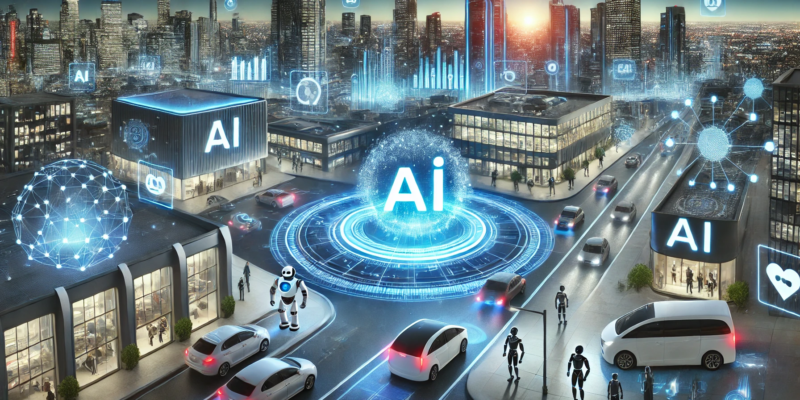
What was once imagined as a distant technological marvel, artificial intelligence (AI) has swiftly become a pivotal component of current technology, leading to unprecedented innovations and revolutionizing how various industries operate and evolve.
With the recent announcement of the Stargate Project, which aims to secure American leadership in AI, create hundreds of thousands of American jobs, and generate substantial economic benefits globally, the momentum for AI applications has never been stronger.
Transforming Industries with AI
AI is revolutionizing industries by automating processes, enhancing decision-making, and creating new business models. This transformation is akin to the introduction of electricity, which powered a new era of innovation and productivity.
Automation and Efficiency:
- AI-powered automation is streamlining repetitive tasks, reducing human error, and increasing efficiency.
- Businesses are leveraging AI to optimize supply chains, manage inventories, and forecast demand more accurately.
- AI-driven quality control processes are ensuring higher product standards.
- Predictive maintenance, powered by AI, is reducing downtime and operational costs.
- AI is enabling faster product development cycles through simulation and modeling.
The manufacturing sector, for example, is witnessing a significant shift with the adoption of AI-driven robots and intelligent systems. These technologies are enhancing production lines, ensuring quality control, and enabling predictive maintenance, which reduces downtime and operational costs.
In the healthcare industry, AI applications are transforming patient care. AI algorithms analyze vast amounts of medical data to assist in diagnosing diseases, personalizing treatment plans, and predicting patient outcomes. Telemedicine platforms, powered by AI, are providing remote consultations and monitoring, making healthcare more accessible and efficient.
The Role of AI in Job Creation and Economic Growth
While there are concerns about AI potentially displacing jobs, it is also creating new opportunities and driving economic growth. The Stargate Project highlights the potential for AI to create hundreds of thousands of jobs and stimulate economic activity.
New Job Opportunities:
- The development and implementation of AI technologies are generating demand for skilled professionals, including data scientists, AI engineers, and machine learning experts.
- AI is also creating jobs in sectors such as cybersecurity, where the need to protect data and systems from increasingly sophisticated threats is paramount.
- The rise of AI-driven startups is creating entrepreneurial opportunities and fostering innovation.
- AI-related services, such as AI strategy consulting and implementation, are becoming lucrative fields.
- Education and training programs focused on AI are creating jobs for instructors and curriculum developers.
As AI becomes more integrated into various industries, there is a growing need for professionals who can work alongside these technologies. This includes roles in AI ethics, governance, and compliance, ensuring that AI systems are developed and used responsibly.
Economic growth driven by AI is not limited to the technology sector. Traditional industries, such as agriculture, retail, and finance, are also benefiting from AI applications. Farmers are using AI-powered tools to monitor crop health, predict yields, and optimize resource usage. Retailers are leveraging AI to personalize customer experiences, manage inventories, and enhance supply chain operations. Financial institutions are adopting AI to detect fraud, assess credit risk, and automate trading.
AI Applications in Everyday Life
AI is becoming an integral part of everyday life, enhancing the way we live, work, and interact. From personal assistants like Siri and Alexa to recommendation algorithms on streaming platforms, AI is making our lives more convenient and personalized.
Smart Homes and IoT:
- AI-powered smart home devices are automating household tasks, improving energy efficiency, and enhancing security.
- The Internet of Things (IoT) is creating interconnected ecosystems where AI enables seamless communication between devices.
- AI is improving home security systems through advanced surveillance and threat detection.
- AI-driven climate control systems are optimizing energy usage for better sustainability.
- AI is enhancing entertainment experiences by adapting content recommendations to user preferences.
AI is also transforming transportation with the development of autonomous vehicles. These self-driving cars use AI algorithms to navigate roads, detect obstacles, and make split-second decisions, promising a future of safer and more efficient travel.
In the realm of entertainment, AI is personalizing content recommendations, creating immersive gaming experiences, and even generating music and art. Streaming services like Netflix and Spotify use AI to analyze user preferences and suggest content tailored to individual tastes.
Education and AI: Preparing for the Future
As AI continues to evolve, there is a growing need to prepare the workforce for the future. Education and training programs are essential in equipping individuals with the skills required to thrive in an AI-driven world.
AI in Education:
- AI-powered tools are transforming the way we learn, providing personalized learning experiences and real-time feedback.
- Online courses and training programs, such as the Building AI Applications for Agencies course, are equipping professionals with the skills needed to develop and implement AI solutions.
- AI-driven tutoring systems are providing personalized support to students.
- Educational institutions are incorporating AI into their curricula, offering hands-on experience with AI tools and platforms.
- Lifelong learning programs are helping professionals stay updated with the latest AI advancements and enhance their career prospects.
Educational institutions are integrating AI into their curricula, teaching students about AI principles, ethics, and applications. This includes hands-on experience with AI tools and platforms, preparing students for careers in this rapidly growing field.
Lifelong learning is becoming increasingly important as AI continues to reshape industries and job roles. Professionals are seeking continuous education to stay updated with the latest AI advancements and enhance their career prospects.
AI Ethics and Responsibility
With the widespread adoption of AI, ethical considerations and responsible use are becoming increasingly important. Ensuring that AI technologies are developed and used ethically is crucial to building trust and preventing unintended consequences.
Ethical AI Development:
- AI systems should be designed to be fair, transparent, and accountable.
- Addressing biases in AI algorithms is essential to prevent discrimination and ensure equitable outcomes.
- Organizations should establish AI ethics committees to guide responsible development and deployment.
- Transparency in AI decision-making processes is crucial for building trust.
- Protecting user privacy and data security is a fundamental aspect of ethical AI use.
Organizations are establishing AI ethics committees and frameworks to guide the responsible development and deployment of AI technologies. These initiatives focus on addressing potential biases, ensuring transparency, and protecting user privacy.
AI governance is also critical in regulating the use of AI. Governments and regulatory bodies are developing policies and standards to oversee AI applications, ensuring that they align with societal values and legal requirements.
The Future of AI
The future of AI is full of promise and potential. As technology continues to advance, AI will play an even more significant role in shaping our world.
AI Research and Innovation:
- Ongoing research in AI is pushing the boundaries of what is possible, leading to breakthroughs in fields such as natural language processing, computer vision, and robotics.
- Innovation in AI is driving the development of new applications and solutions that address global challenges, from climate change to healthcare.
- Collaboration between academia, industry, and government is essential to advancing AI research.
- Public and private sector partnerships are fostering innovation and creating opportunities for cutting-edge AI technologies.
- Investing in AI research and education is crucial for securing future economic growth and competitiveness.
Collaboration between academia, industry, and government is essential to advancing AI research and ensuring that its benefits are widely shared. Public and private sector partnerships are fostering innovation and creating opportunities for the development of cutting-edge AI technologies.
The Stargate Project, with its focus on securing American leadership in AI, is a testament to the transformative potential of AI. By investing in AI research, development, and education, we can harness the power of AI to drive economic growth, create jobs, and address some of the world’s most pressing challenges.
There can be little doubt that the time of AI applications is now. With the potential to revolutionize industries, create new job opportunities, and enhance our everyday lives, AI is poised to be a driving force in the future of technology. As we continue to innovate and explore the possibilities of AI, it is crucial to prioritize ethical considerations and ensure that AI is used responsibly for the benefit of all.