Course Description
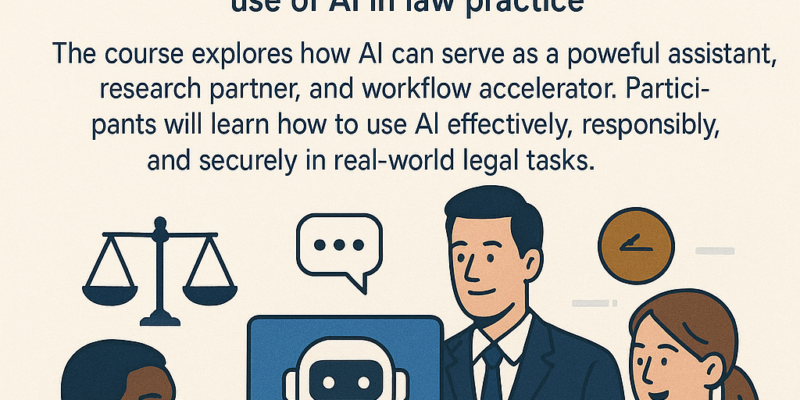
PAI (Partner with AI) introduces legal professionals to the practical use of AI in law practice. The course explores how AI can serve as a powerful assistant, research partner, and workflow accelerator. Participants will learn how to use AI effectively, responsibly, and securely in real-world legal tasks.
By the end of the course, participants will understand how to:
- Use AI as an assistant
- Ask better questions, analyze documents, and draft faster with domain-specific AI.
- Leverage AI as an intelligent document vault
- Securely store, organize, and bulk-analyze legal documents.
- Expand knowledge and research capabilities
- Investigate complex legal, regulatory, and tax issues across multiple domains.
- Streamline legal workflows
- Run pre-built workflows or design firm-specific processes with AI support.
- Enhance drafting and review
- Draft, edit, and review contracts with AI-powered assistance.
Learning Outcomes
After completing this course, participants will be able to:
- Interact with AI effectively using precise prompts and queries.
- Select and evaluate appropriate AI tools for specific legal tasks.
- Develop simple scripts for AI interaction (optional).
- Use AI to co-create scripts and workflows (optional).
- Organize and prepare private documents for AI-based implementation.
- Structure conversations with AI around firm-specific or client documents.
Audience
- Lawyers
- Paralegals
- Legal professionals exploring AI in practice
Skill Level
- Beginner to Intermediate
Duration
- One day (flexible format)
Prerequisites
- General interest in AI and its applications in law (no prior technical knowledge required)
Format
- 50% lectures and discussion
- 50% hands-on labs
Lab Environment
- Zero Install — No software installation required on student machines.
- Cloud-based labs — A secure lab environment will be provided.
Students will need:
- A modern laptop with an unrestricted Internet connection
- (Laptops behind restrictive VPNs/firewalls may encounter issues; a connectivity checklist will be provided.)
- Chrome browser
Available Tools
AI for legal practice comes in many forms. We will cover the following tools and their strengths:
- Harvey – A specialized AI platform for legal research and drafting, designed specifically for law firms.
- CoCounsel (Casetext/Thomson Reuters) – An AI assistant for document review, deposition prep, and legal research.
- Spellbook – Contract drafting and review integrated into Microsoft Word.
- DoNotPay – AI-driven consumer rights and legal automation tool.
- Other emerging tools – Brief analysis, due diligence automation, and eDiscovery platforms.
We will compare capabilities, pricing models, and adoption across firms.
What if I Have Only ChatGPT?
Not every firm will start with dedicated legal AI tools. Many tasks can still be handled using general-purpose AI like ChatGPT:
- Drafting letters, memos, and contracts with careful review.
- Summarizing case law, statutes, or client documents.
- Brainstorming legal strategies or arguments.
- Creating structured workflows (step-by-step task outlines).
- Automating repetitive writing tasks with custom prompts.
Limitations:
- ChatGPT is not specialized in law and may produce errors (“hallucinations”).
- Requires human oversight and fact-checking.
- Does not provide legal advice or replace professional judgment.
Best practice: Use ChatGPT as a productivity partner for drafting and research — but always verify sources and outcomes before relying on results.
Detailed Outline
Module 1: Introduction to AI in Law
- What is AI? Myths vs. reality
- Why “Partner with AI” instead of competing with it
- Use cases across litigation, corporate, compliance, and tax
Module 2: Talking to AI the Right Way
- Basics of prompt engineering
- How to ask precise legal questions
- Hands-on lab: drafting queries and reviewing responses
Module 3: Using General-Purpose AI (ChatGPT)
- Drafting contracts, memos, and emails
- Summarizing statutes, cases, and documents
- Lab: Uploading/summarizing a sample legal document
- Limitations and safeguards
Module 4: Specialized Legal AI Tools
- Overview of Harvey, CoCounsel, Spellbook, DoNotPay
- Live demos or guided walkthroughs
- Comparison of features, pricing, and adoption trends
Module 5: AI and Legal Workflows
- Automating repetitive tasks (due diligence, document review)
- Designing workflows tailored to your practice
- Lab: Build a simple AI-powered workflow
Module 6: Security, Ethics, and Confidentiality
- Risks of using AI with client data
- ABA guidance and regulatory updates
- Best practices for secure, compliant use
Module 7: Building AI Readiness in Your Practice
- Organizing private documents for AI systems
- Structuring firm-specific workflows
- Creating a roadmap for adoption
Module 8: Wrap-Up and Next Steps
- Review of key concepts
- Checklist for evaluating AI tools
- Q&A and resources for further learning